




Web Application Penetration Testing



Why choose Citation Cyber?

Expert Support
Testing by CHECK-assured expert penetration testers.

Simple platform
Delivered through Cyber Atlas, your platform for managing cyber risk.

Every sector
SMEs, public sector, care providers, early years, education, professional services.
What is web application penetration testing?
Web application penetration testing is when ethical hackers attempt to break into your application to uncover vulnerabilities before malicious actors can exploit them.
We carry out controlled, simulated attacks on your website from external and internal perspectives. Everything from your public-facing interface to the underlying systems that store and process sensitive data gets examined.
The goal is simple: identify risks early and give you clear, practical steps to fix them.


Why test your web application?
Protect customer data
Keep sensitive information safe from breaches
Meet compliance
Satisfy regulatory and insurance requirements
Build trust
Show customers you take security seriously
Stay operational
Prevent disruptions to your business
When you need web application penetration testing

Public-facing applications
If your web app handles sensitive or regulated data (customer information, payment details, health records), you need testing.

Pre-release security
Launching a new app or major update? Test it before it goes live. It’s cheaper and easier to fix vulnerabilities now than after launch.

Internal business apps
Applications with elevated privileges or access to critical systems need testing too. Insider threats are real, whether accidental or malicious.

Compliance requirements
Whether it’s for regulatory compliance, client contracts, or insurance requirements – we provide the evidence you need.
Citation Cyber’s web application penetration testing process

Discovery phase
We learn about your assets, environment, and goals.
Pre-testing
Confirm scope, approach, and logistics, including setup
Testing
UK-based experts simulate real-world attacks on your external perimeter.
Reporting in Atlas
You’ll receive a clear breakdown of findings, fixes and actions in our Atlas platform.
Review, retest
We walk you through the results and retest high/criticals at no extra cost.
How we can test your web application
Before any testing takes place, you’ll have a kick off call with a security consultant to walk you through what we’ll do, discuss potential risks, and answer any questions you have.

Testing with full knowledge of your application, including architecture and configuration, to identify deeper vulnerabilities efficiently.
Best for: Targeted assurance and in-depth security reviews.
Testing with partial knowledge to simulate a trusted user or compromised account – reflecting how many real-world attacks occur.
Best for: Realistic risk insight and balanced coverage.
Testing with no prior knowledge, replicating an external attacker approaching your application from scratch.
Best for: Baseline assessments and external exposure testing.
What happens next?
After your web application penetration test, you’ll receive a detailed report in our all-in-one platform, Atlas. It’ll show what we found and what to do next.
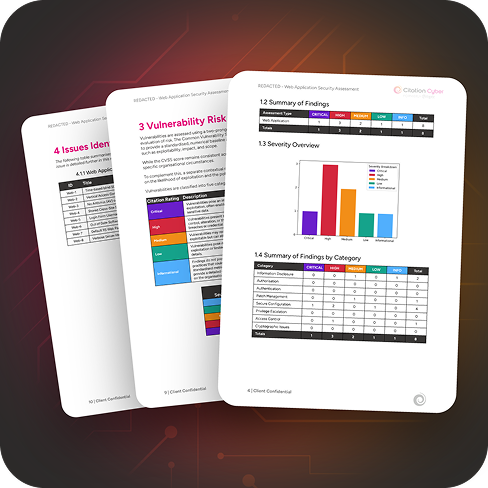
In your report, you’ll see:
- High-level executive summary
- Technical and remediation summaries
- Vulnerabilities with clear risk ratings (Citation Score & CvSS Score)
- Description, impact, evidence for each vulnerability
- Short- and long-term remediation guidance
- Technical detail for your IT team or MSP
- Free retest results
What is CHECK-certified penetration testing?
CHECK is the National Cyber Security Centre’s (NCSC) approved scheme for penetration testing, and the UK government’s standard for how testing should be done.
For many organisations, CHECK certification is also a requirement for public sector work, compliance, and reassuring clients and stakeholders that security has been properly tested.
Read about CHECK pen testing and how it differs from CREST here.
Protect your systems all year round
A penetration test shows you where you stand today, but threats don’t stand still. Reduce your risk of a security breach with vulnerability scanning that provides 365 days’ protection. So you can identify and fix vulnerabilities throughout the year.

Impact of not testing your web application
Average UK data breach cost
Annual turnover in GDPR fines
SMEs new business difficulties post breach
-

 Clare Baldwin
We were really appreciative of Citation Cyber’s Responsiveness to us as our penetration testing needed to be completed very quickly and were able to accommodate this. Communication from the team was really good and the report was comprehensive and easy to follow for us and our developers.
Simple solutions to secure your business
Expert protection against cyber threats.

Penetration Testing
Identify risks with expert-led simulated attacks to protect your data and systems.

Cyber Essentials Certification
Achieve Cyber Essentials certification to defend against common threats, whatever your business size.

Employee Awareness Training
Empower your team to be your first line of defence with easy, interactive training.

Phishing Simulator & Bespoke Campaigns
Simulations to teach your staff how to spot and stop phishing scams easily.

Intelligent Monitoring & Vulnerability Scanning
Stay protected between pen tests with continuous scanning and real-time breach alerts.

Cyber Security Consultancy
Tailored advice for compliance, ransomware plans, and board-level cyber support.

Cyber Security Compliance
Simplify policies with NCSC-approved templates and hassle-free management tools.

Questions about web penetration testing
Your web penetration test will cause minimal disruption to your day to day operations. We’ll work with you to make sure we minimise any potential impact.
No, you don’t need to take your application offline during testing. We conduct penetration testing in a controlled way that minimises disruption. For production environments, we coordinate timing with you to avoid peak usage periods. You can also provide us with a staging or test environment if you prefer.
A vulnerability scan is automated software that checks for known weaknesses. Penetration testing is a manual process where security experts actively attempt to exploit vulnerabilities the way a real attacker would. Scans find surface-level issues. Pen tests uncover complex attack chains, logic flaws, and business logic vulnerabilities that automated tools miss.
Test your web application annually at minimum, or whenever you make significant changes to your application including new features, integrations, or architecture updates. If your app handles payment card data, PCI DSS requires penetration testing at least once a year and after any significant changes.
Yes. Firewalls and antivirus protect your network perimeter and endpoints. They don’t test whether your application code itself has vulnerabilities like SQL injection, cross-site scripting, authentication flaws, or insecure data handling. Penetration testing finds those application-layer weaknesses.