




External infrastructure penetration testing




Why choose Citation Cyber?

Expert support
Testing by CHECK-approved and CREST-certified penetration testers.

Single platform
Delivered through Atlas, your one stop shop for managing cyber risk.

Every sector
SMEs, public sector, care providers, early years, education, professional services.
What is external penetration testing?
Your external infrastructure is everything connected to the internet, like web servers, firewalls, VPN gateways and IP addresses. These are often where attackers look first.
An external penetration test, or external infrastructure assessment, simulates real-world attacks on those systems to find weaknesses before anyone exploits them.


Why external infrastructure penetration testing matters
Attackers scan the internet constantly, looking for systems they can break into. Overlooked services and outdated devices can expose your wider network.
Regular external penetration testing helps you:
- Prevent unauthorised access to sensitive systems and data
- Close easy entry points before attackers find them
- Stay compliant with industry standards
- Strengthen overall resilience by spotting risks early
What’s included in our external
penetration testing services

Identification of applications and services running on your IP addresses

Detailed vulnerability scanning and manual verification

Real-world exploitation attempts where safe and appropriate

Configuration and service review

Assesses authentication, access controls, and exposed services

Prioritised list of risks with practical fixes and free retest on high/critical vulnerabilities
Our external penetration testing process
Assess and secure your external infrastructure in five simple steps with our CHECK and CREST certified ethical hackers.

Discovery phase
We learn about your assets, environment, and goals.
Pre-testing
You have a kick off call and send across what we need for testing.
Testing
UK-based experts simulate real-world attacks on your external perimeter.
Reporting
You’ll receive a clear breakdown of our findings and fixes in Atlas.
Review, retest
We walk you through the results and retest high/critical risks for free.

How we test your external environment
Before any testing takes place, you’ll have a kick off call with an ethical hacker to walk you through what we’ll do, discuss potential risks, and answer any questions you have
White box
We test with full knowledge of your external systems to understand how far an attacker could go if your perimeter was breached.
Best for: Deep assurance, compliance, and mature IT environments.
Grey box
We test with limited information to simulate the access a trusted third party or compromised user might have.
Best for: Practical risk insight without full system exposure.
Black box
We test with no prior knowledge, just like a real attacker scanning the internet for weaknesses.
Best for: First-time testing or establishing a baseline.
What happens next?
After the assessment, you’ll get a clear, actionable report that shows what’s vulnerable, how serious it is, and what to fix first in our all-in-one platform Atlas.
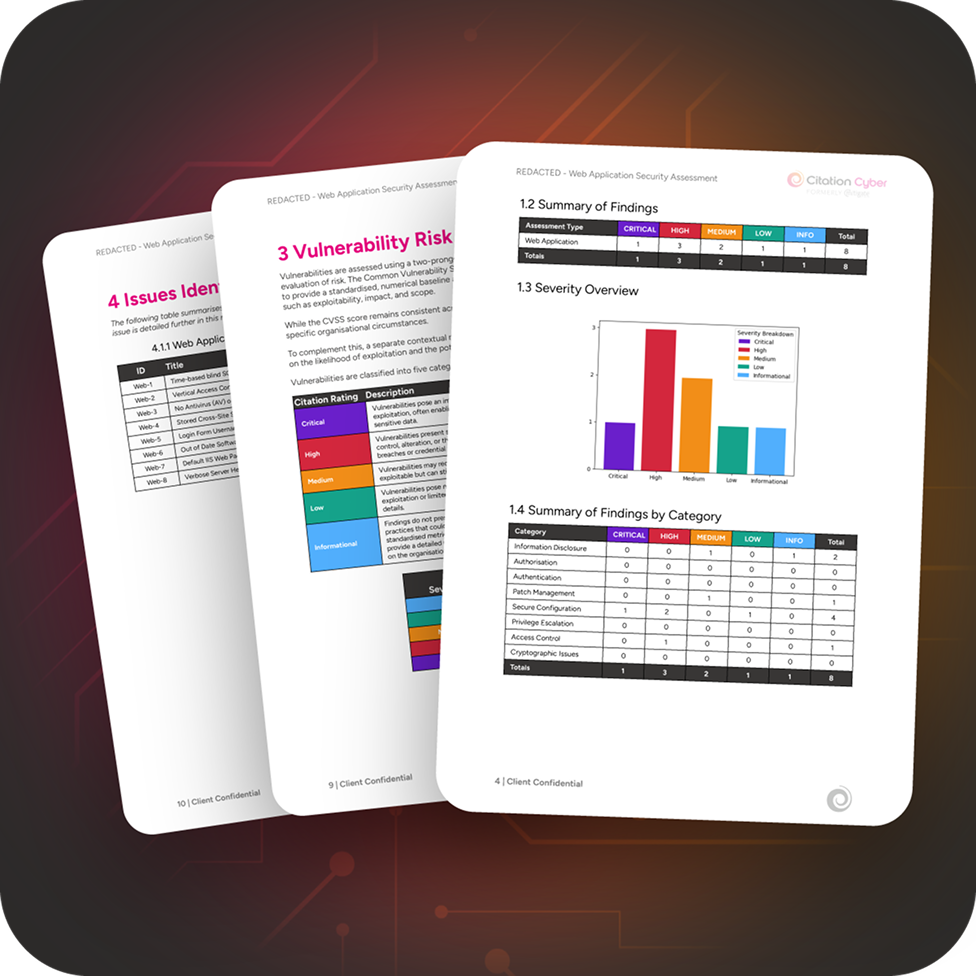
In your report, you’ll see:

High-level executive summary
Technical and remediation summaries
Vulnerabilities with clear risk ratings (Citation Score & CvSS Score)
Description, impact, evidence of each vulnerability
Short- and long-term remediation guidance
Technical detail for your IT/MSP
Free retest results
What is CHECK-certified penetration testing?
CHECK is the National Cyber Security Centre’s (NCSC) approved scheme for penetration testing, and the UK government’s standard for how testing should be done.
A CHECK-certified external penetration test is carried out by trusted, assured experts using recognised, industry-approved methods.
For many organisations, CHECK certification is also a requirement for public sector work, compliance, and reassuring clients and stakeholders that security has been properly tested.
Read about CHECK pen testing and how it differs from CREST here.
Protect your systems all year round
A penetration test shows you where you stand today, but threats don’t stand still. Reduce your risk of a security breach with vulnerability scanning that provides 365 days’ protection. So you can identify and fix vulnerabilities throughout the year.
UK breaches 2026
average significant attack cost per business
total business breaches
businesses reported a breach or attack
Why our customers love us
Expert protection against cyber threats
-
 Amanda Bailey
Quorum Logistics Support Limited
Amanda Bailey
Quorum Logistics Support Limited
An extremely friendly, knowledgeable, and experienced team from start to finish.

-
 Brian Wheatley
Medical-Legal Appointments Ltd
Brian Wheatley
Medical-Legal Appointments Ltd
Citation Cyber have been outstanding throughout what has been a challenging test this year, Lee (Cyber Essentials Assessor) has been brilliant from start to finish, he’s understood the challenges and advised and accommodated every question. BIG thanks from MLA.
-
 Clare Baldwin
Quantum Health Solutions
Clare Baldwin
Quantum Health Solutions
We were really appreciative of Citation Cyber’s Responsiveness to us as our penetration testing needed to be completed very quickly and were able to accommodate this. Communication from the team was really good and the report was comprehensive and easy to follow for us and our developers.
-
 Jason Cass
Royal British Legion Industries
Jason Cass
Royal British Legion Industries
A fantastic service done by Citation again for our Cyber Essentials Plus award. The engineers within the company work to a very high standard and work well with the customer to explain along the way anything that is raised. They are on-hand to answer any questions, and explain the findings and resolution to aid the certification. A top-quality company that is highly recommended!
-
 Liam Booth
Cubic Interactive Ltd
Liam Booth
Cubic Interactive Ltd
Out of all the companies we approached, Citation were the first to respond to our requests for meetings, they were always available to ask questions to, and were the only ones who really took time to understand us, how our products have been developed and our specific testing needs. I would have no reservations about recommending Citation Cyber to others. Everyone we have spoken to at Citation Cyber have been genuinely nice people, nothing felt ‘salesy’ and we never felt we were being pushed to have anything we didn’t need.
What you can test
What you can test
Our penetration testing services let you test anything that connects to the internet. These tests uncover vulnerabilities and allow us to deliver tailored recommendations that safeguard sensitive data and the systems supporting it.

Penetration Testing
Identify risks with expert-led simulated attacks to protect your data and systems.

Cyber Essentials Certification
Achieve Cyber Essentials certification to defend against common threats, whatever your business size.

Employee Awareness Training
Empower your team to be your first line of defence with easy, interactive training.

Phishing Simulator & Bespoke Campaigns
Simulations to teach your staff how to spot and stop phishing scams easily.

Intelligent Monitoring & Vulnerability Scanning
Stay protected between pen tests with continuous scanning and real-time breach alerts.

Cyber Security Consultancy
Tailored advice for compliance, ransomware plans, and board-level cyber support.

Cyber Security Compliance
Simplify policies with NCSC-approved templates and hassle-free management tools.

Frequently asked questions
External infrastructure penetration testing is a security assessment that simulates real-world attacks on your internet-facing systems, including web servers, firewalls, VPN gateways, and IP addresses. Citation Cyber’s CHECK-assured, CREST-certified ethical hackers identify vulnerabilities before malicious actors can exploit them.
External infrastructure penetration testing can typically take from a few days to multiple weeks for active testing depending on your systems and requirements.
Your external infrastructure penetration test will cause minimal disruption to your day to day operations. We’ll work with you to make sure we minimise any potential impact.
The difference between the two is where the test is carried out. External infrastructure pen testing is conducted remotely by an ethical or ‘white hat hacker’ to find vulnerabilities in an organisation’s external systems.
Internal infrastructure pen testing, on the other hand, is carried out inside an organisation’s systems to understand what could happen if a hacker gained access to its network. Find out more about our internal infrastructure penetration testing service here.
You should run external infrastructure penetration tests at minimum once a year, but even more regularly for high-risk sectors and after any significant system changes.


Ready to get started?
