




Mobile Application Penetration Testing



Why choose Citation Cyber?

Expert support
Testing by CHECK-assured expert penetration testers.

Simple platform
Delivered through Cyber Atlas, your platform for managing cyber risk.

Every sector
SMEs, public sector, care providers, early years, education, professional services.
What is mobile application penetration testing?
Mobile penetration testing or mobile app penetration testing, is a manual, consultant-led security assessment of your iOS or Android app. It looks at how the app stores data, authenticates users, and interacts with your backend services and APIs.
The goal is to find where your app exposes sensitive data, on the device or through the systems it connects to, and how an attacker could exploit it, so you can fix it first.

Why mobile penetration testing matters
Mobile apps run on devices you don’t control, carrying data you’re responsible for. A weakness in the app itself can expose that data or give an attacker a way into the systems it connects to.
Regular mobile penetration testing means you can:
- Stop data leaking from local storage or insecure communication
- Close authentication and access control gaps before they’re exploited
- Protect the backend services and APIs your app talks to
- Meet client, regulatory or pre-release testing requirements
What’s included in our mobile app penetration testing services

Manual review of app logic and functionality on iOS and/or Android

Real-world exploitation attempts where safe and appropriate

Assessment of local data storage and how sensitive information is handled on the device

Prioritised list of risks with practical fixes

Testing of authentication mechanisms and session handling

Assessment of the app’s resistance to running on jailbroken or rooted devices, tampering and reverse engineering

Review of how the app communicates with backend services and APIs, including transport security and certificate validation

Free retests on high and critical vulnerabilities

Your four steps to certification with us
Discovery phase: We learn about your app, its architecture, and your goals.
Pre-testing: Complete the questionnaire via the user hub, Atlas
Testing: Consultants manually assess your app, following OWASP Mobile Application Security Testing Guide (MASTG) and verifying against Mobile Application Security Verification Standard (MASVS).
Reporting in Atlas: You’ll receive a clear breakdown of findings, fixes and actions in Atlas.
Review, retest: We walk you through the results and answer any questions.
Manual testing vs vulnerability scanning
Not every mobile app needs the same depth of testing straight away.
Mobile app penetration testing
Manual, consultant-led testing that investigates app logic, authentication and backend interaction in depth. Best for apps handling sensitive or regulated data, pre-release assurance, and regulatory or client-driven testing requirements.
Mobile app vulnerability scanning
Automated and semi-automated scanning that flags known vulnerabilities and insecure configurations across your app estate. Best for baseline visibility, early-stage mobile security programmes, or testing large numbers of apps on a budget.
Many clients use vulnerability scanning to cover their broader app estate, then bring in manual penetration testing for the apps that pose the most risk.
What happens next?
After your mobile application testing, you’ll get a clear, actionable report that shows what’s vulnerable, how serious it is, and what to fix first, in our all-in-one platform, Atlas.
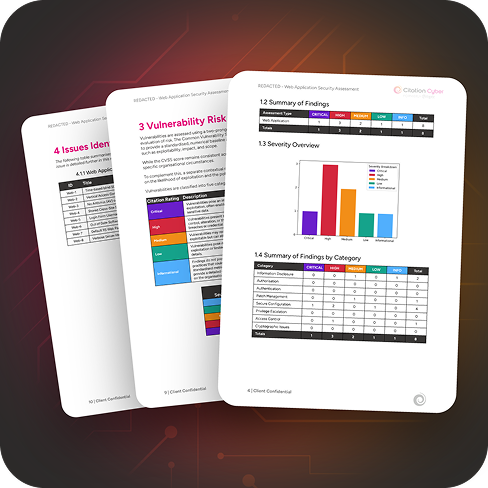
In your report, you’ll see:
- High-level executive summary
- Technical and remediation summaries
- Vulnerabilities with clear risk ratings (Citation Score & CvSS Score)
- Description, impact, evidence for each vulnerability
- Short- and long-term remediation guidance
- Technical detail for your IT team or MSP
- Free retest results
Protect your systems all year round
A penetration test shows you where you stand today, but threats don’t stand still. Reduce your risk of a security breach with vulnerability scanning that provides 365 days’ protection. So you can identify and fix vulnerabilities throughout the year.
Citation Cyber’s penetration testing services

Network Infrastructure
Spot the gaps in your routers, switches and firewalls with simulated attacks that show exactly where you’re exposed.

VoIP
Check your VoIP setup for weaknesses hackers look for, from call recordings to unsecured phone systems.

Web Application
Test your website and web apps for the coding and configuration flaws attackers use to break in and steal data.

Database
Find out if your databases are properly locked down, with testing that checks access controls and data integrity.

WiFi Network
Put your wireless network through its paces, checking the encryption, authentication and configurations that keep attackers out.

Mobile App and Devices
Test your mobile apps and devices for weaknesses in code, data storage and communication that could expose your data.

Cloud
Check your cloud environment for misconfigurations, weak access controls and gaps in data protection before they’re exploited.


UK breaches 2026
*
Average significant attack cost per business
Total business breaches
Businesses reported a breach or attack
-

 Clare Baldwin
We were really appreciative of Citation Cyber’s Responsiveness to us as our penetration testing needed to be completed very quickly and were able to accommodate this. Communication from the team was really good and the report was comprehensive and easy to follow for us and our developers.
Common questions
Mobile app penetration testing is a manual security assessment that simulates real-world attacks on your iOS or Android app. Citation Cyber’s mobile app penetration testing services use certified ethical hackers to test app logic, local data storage, authentication and backend communication, finding vulnerabilities before they can be exploited.
Our mobile penetration testing covers both iOS and Android applications, tailoring the assessment to the app’s platform and architecture.
Mobile penetration testing is manual and consultant-led, digging into app logic and real exploitation. A vulnerability scan is automated or semi-automated, giving broad coverage of known issues without manual validation. Scanning works well for ongoing visibility; penetration testing is better where the app is high-risk or handles sensitive data.
We work with you to schedule testing around your release cycle and keep disruption to a minimum.
Test before major releases, after significant changes to app functionality, and at least once a year for apps that are already live.
Our mobile penetration testing looks at how the app communicates with backend services and APIs. Where the backend itself needs deeper testing, this is often paired with a Web Application or API Security Assessment.